

Best Practices for Tax-Deductible Online Giving in 2026
 Waleed
Giving to charity online is convenient, but a successful payment does not automatically mean your donation qualifies for a tax deduction. Before contributing, check whether the organization is eligible, use a secure payment method, and keep records that support your gift.
For the 2026 tax year, charitable giving also comes with important federal tax changes. Eligible taxpayers who take the standard deduction may now qualify for a deduction for certain cash contributions, while people who itemize face a new limitation. Understanding these rules can help you give confidently and avoid surprises when filing your taxes.
>> Related Post: Best Charities to Donate to for Tax Deduction in 2026
Best Practices to Follow When Making Tax-Deductible Online Donations in 2026:
1. Check Whether the Charity Qualifies
Before donating, confirm that the organization is eligible to receive tax-deductible contributions. In the United States, many eligible charitable organizations are recognized under Section 501(c)(3) of the Internal Revenue Code, but a nonprofit label alone is not enough to establish deductibility.
The IRS provides a free Tax Exempt Organization Search tool where you can search for an organization by name or Employer Identification Number (EIN). Check its listing and deductibility information before making a gift.
It is also worth reviewing the charity’s official website. Look for a clear explanation of its mission, programs, leadership, and financial reporting. A legitimate organization should make it reasonably easy to understand what it does and how to learn more about its work.
Before giving, check:
- Whether the organization is eligible to receive tax-deductible contributions.
- Whether its mission aligns with the cause you want to support.
- Whether its website provides clear contact and organizational information.
- Whether you can find financial reports, annual reports, or other accountability information.
2. Understand the 2026 Charitable Deduction Rules
The tax treatment of charitable contributions changed in 2026. Your eligibility depends on how you file your taxes, the type of gift you make, and the organization receiving it.
If you take the standard deduction
Beginning with the 2026 tax year, eligible taxpayers who do not itemize may deduct qualifying cash contributions to eligible charitable organizations, up to $1,000 for an individual or $2,000 for married couples filing jointly. The deduction is claimed on 2026 tax returns filed in 2027.
The rules have limitations. For example, contributions to donor-advised funds generally do not qualify for this non-itemizer deduction. Check the IRS guidance for non-itemizers to confirm eligibility and recordkeeping requirements.
If you itemize deductions
Taxpayers who itemize can generally deduct qualifying charitable contributions, subject to applicable limits. Starting in 2026, however, a new floor applies: charitable contributions are deductible only to the extent they exceed 0.5% of adjusted gross income (AGI). Other deduction limits may apply as well.
This means the tax benefit will vary by taxpayer. A donation does not reduce your tax bill dollar for dollar, and the amount you can deduct may differ from the amount you give.
Which types of gifts qualify?
The rules depend on the contribution and the recipient. As a general guide:
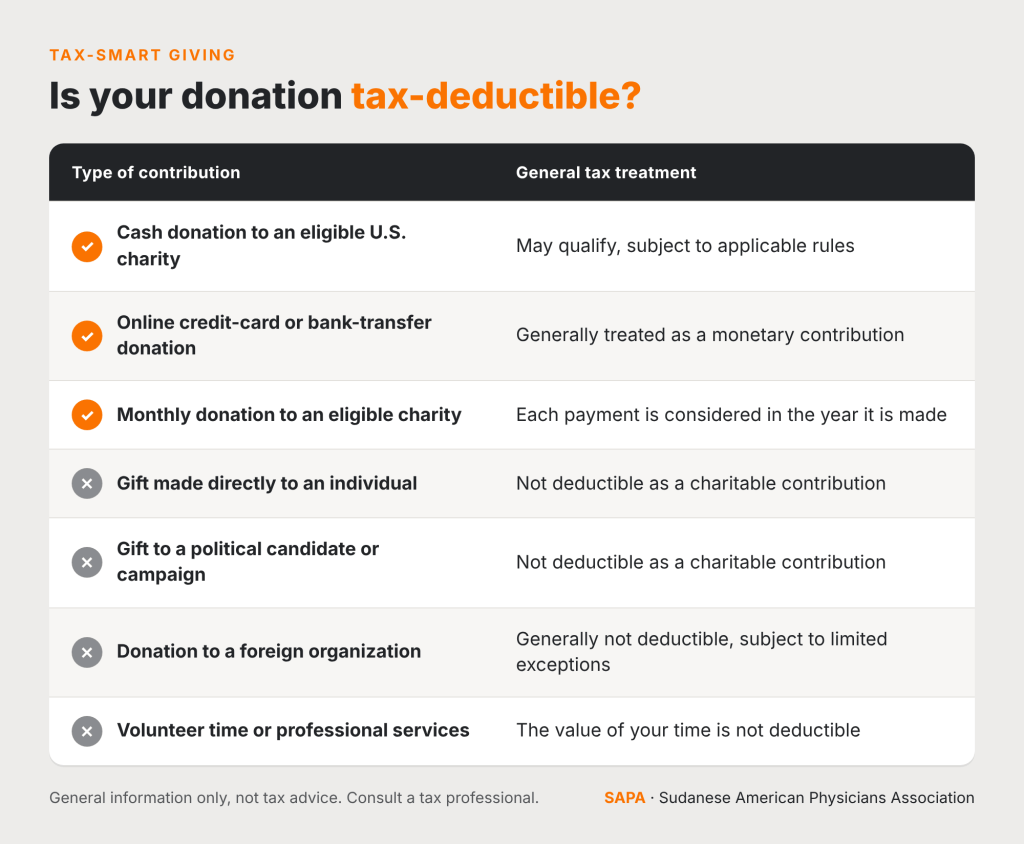
This table is a general guide, not a substitute for checking the rules that apply to your particular gift. The IRS’s Publication 526 on charitable contributions explains eligible organizations, contribution types, and limitations in greater detail.
3. Give Through a Secure Website
Online donations are convenient, but scammers sometimes imitate real charities or create misleading fundraising pages. A few checks can help protect your payment and personal information.
- Use the charity’s official website. If you receive a donation request by email, text, or social media, avoid clicking an unexpected link. Search for the organization independently and navigate to its official website.
- Check the web address. Make sure the domain is spelled correctly and that you are on the intended organization’s website. HTTPS is an important security feature, but it does not, by itself, prove that a website or fundraiser is legitimate.
- Review the payment page. Check the donation amount, payment frequency, and any additional fees before submitting your gift. If you select a recurring donation, make sure you understand how often you will be charged and how to change or cancel it.
- Keep your payment details private. Never share passwords, one-time security codes, or other sensitive account information in response to an unsolicited donation request.
Credit cards and reputable payment services can offer useful transaction protections, but no payment method eliminates every risk. If something about the request seems suspicious, pause and verify the organization before proceeding.
4. Keep Receipts and Donation Records
A donation confirmation email is useful, but it is only one part of good recordkeeping. The IRS requires a written record for monetary contributions, regardless of the amount. This can include a bank record or a written communication from the charity showing the organization’s name, the date, and the amount of the contribution.
For a single contribution of $250 or more, you generally need a contemporaneous written acknowledgment from the charity to claim a deduction. The acknowledgment must contain the required information, including whether the organization provided goods or services in return for the gift.
For online giving, a simple recordkeeping system is usually sufficient:
- Save the donation confirmation email.
- Keep bank or credit-card statements showing the transaction.
- Record the charity’s name, the donation date, and the amount.
- Retain the required written acknowledgment for gifts of $250 or more.
- Keep recurring-donation confirmations and records of each payment.
You do not generally attach donation receipts to your tax return, but you should retain the records in case you need to substantiate your deduction. See the IRS’s guidance on charitable contribution acknowledgments.
5. Pay Attention to Timing and Recurring Gifts
If you want a donation to count toward the 2026 tax year, make sure the contribution is completed within the applicable period. For a credit-card gift, the contribution is generally considered made in the year the charge occurs, even if you pay your credit-card bill later.
Do not wait until the final minutes of December 31. Payment failures, processing delays, or uncertainty about when a transaction was completed can complicate your records.
Recurring donations can make charitable giving easier to manage. They also help organizations plan their budgets and programs around more predictable contributions. Before setting up a monthly gift, check the payment schedule, confirmation emails, and cancellation process.
Each payment is generally considered in the year it is made. For example, a monthly donation charged throughout 2026 is generally considered across the 2026 tax year rather than treated as one contribution made at the start of the year.
6. Avoid Common Online Giving Mistakes
Even when a donation is made with good intentions, a few common mistakes can create problems later.
- Assuming every nonprofit gift is deductible. Check the organization’s eligibility and the rules that apply to your contribution rather than relying on the word “nonprofit” alone.
- Donating through a personal fundraiser without checking the tax treatment. Contributions made directly to an individual are generally not deductible, even if the person is facing a serious hardship. Giving through a qualified charity may be treated differently, provided the organization retains the required control over the funds.
- Forgetting that gifts with benefits may be only partly deductible. If you receive goods or services in return, such as a dinner ticket or merchandise, the deductible amount is generally reduced by the value of the benefit.
- Keeping no payment records. Even small monetary gifts require appropriate records if you intend to claim a deduction.
- Assuming every donation produces a tax saving. A tax deduction is not the same as a tax credit. Your actual benefit depends on the rules, your filing status, and your financial circumstances.
7. Choose a Charity That Matches Your Values
Tax eligibility is only one part of a good giving decision. It is also worth understanding what an organization does, which communities or causes it supports, and how it reports its activities.
A practical way to compare charities is to ask:
- Mission: Does the organization work on a cause you care about?
- Programs: Can you understand what its programs actually provide?
- Transparency: Does it publish financial information or annual reports?
- Evidence: Does it explain its work with credible information and measurable results where available?
- Donation process: Are payment terms, recurring charges, and donation confirmations clear?
>> Related Post: Key Benefits of Tax-Deductible Donations for Donors in 2026
Give Year-End Donations (Fastest & Secure) 👇
Make a Tax-Deductible Donation to SAPA
Looking to make your charitable giving count while potentially benefiting from a tax deduction? Consider supporting the Sudanese American Physicians Association (SAPA). As a U.S.-registered 501(c)(3) nonprofit (EIN: 83-3464851), SAPA provides essential healthcare and humanitarian assistance to communities affected by the ongoing crisis in Sudan.
Every contribution can help SAPA continue delivering vital support, from emergency medical care and food assistance to clean water initiatives. No matter the amount, your generosity can help address urgent needs and support vulnerable communities.
→ Make a Year-End Donation to SAPA and help bring healthcare, food and clean water to people who need them most.

FAQs
1. Are online donations to SAPA tax-deductible?
Yes. SAPA is a registered 501(c)(3) nonprofit (EIN 83-3464851), so online donations are tax-deductible to the extent allowed by law.
2. What documents do I need for tax filing?
Keep the receipt or confirmation for every gift. For any single gift of $250 or more, you need a written acknowledgment from the charity showing the amount, the date, and whether you received anything in return. See IRS Publication 526 for details.
3. Do international relief donations qualify for U.S. tax deductions?
They do when you give through a U.S.-registered 501(c)(3) like SAPA. Gifts made directly to foreign organizations generally aren’t deductible.
4. When should I make an online donation for it to count toward my 2026 taxes?
For most online donations, the timing depends on when the payment is completed under the applicable tax rules. Credit-card contributions are generally counted in the year the charge is made. To avoid year-end delays, donate before December 31 and save your confirmation. Special rules may apply to other payment methods.
5. Do I need to report charitable donations if I am not claiming a tax deduction?
You generally do not report a charitable gift simply because you made it. However, if you plan to claim a deduction, you must meet the applicable eligibility, filing, and recordkeeping requirements. Keep donation records even if you are unsure whether you will claim a deduction.


Comment (1)
Year-End Donations in 2025: Practical Tips and Key Benefits
[…] donations, and planned giving systems to support causes more sustainably. Year-end giving is the best practice for Tax-Deductible giving for donors to align their financial planning with their philanthropic values, creating meaningful […]