

What to Look for When Choosing a Charity for Year-end & Holiday Giving
 Mahnoor
The holidays have a way of opening our hearts and our wallets. Between GivingTuesday and the last stroke of midnight on December 31, inboxes fill with appeals, and every cause feels urgent. That’s not just a feeling. December brings in about 40% of the average nonprofit’s annual online one-time revenue, and December 31 alone accounts for roughly 5%.
Americans are generous all year long, too. Giving USA estimates that U.S. charities received $617.2 billion in 2025, and individuals gave 64% of it. With that much money in motion, it pays to slow down and ask a simple question: Is this charity the right home for my gift?
This guide walks you through what to look for when choosing a charity for year-end and holiday giving, from checking legitimacy to measuring real impact, so your generosity goes exactly where you mean it to.
Why Year-End Is the Best Time to Give Wisely
Year-end giving is about more than a tax receipt. Many nonprofits plan their next year’s programs around what comes in during December. A thoughtful gift now can keep a clinic open, a kitchen running, or a water point working well into the new year.
The flip side? The holiday rush is also when scammers get busy. Fake charities copy real names, send urgent texts, and push for gift cards or wire transfers. A few minutes of research protects both you and the people you want to help.
>> Related Post: Turn One Donation Into Two: SAPA’s Matching Gift Guide
What to Look for When Choosing a Charity: 6 Point Checklist
1. A Clear Mission That Matches Your Values
Start with the “why.” What do you care about most: children’s health, hunger, clean water, disaster relief? A good charity can explain its mission in a sentence or two, and its programs should clearly serve that mission.
Ask yourself:
- Does this matter to me personally?
- Do I want to support local needs or international aid?
- Would I rather fund emergency relief or long-term solutions, or both?
2. Verified Legitimacy and 501(c)(3) Status
Before you give, confirm the organization is real and tax-exempt. The IRS Tax Exempt Organization Search lets you look up any charity by name or EIN in seconds.
Red flags to watch for:
- Names that sound almost like a well-known charity
- Pressure to give “right now”
- Requests for cash, gift cards, crypto, or wire transfers
- Vague answers about where the money goes
3. Financial Transparency You Can Actually Read
Trustworthy charities don’t hide their numbers. Look for a recent annual report and the organization’s Form 990, the IRS filing that shows how money is split between programs, salaries, and fundraising. You can find most 990s for free on ProPublica’s Nonprofit Explorer.
A charity’s financial reports should help you understand how it uses donations, including spending on programs, administration, fundraising, and the staff and systems needed to deliver its work. Rather than relying on one percentage, consider the organization’s financial transparency, governance, reported results, and ability to deliver its programs effectively. In humanitarian settings, logistics, security, and local partnerships can be essential to reaching people safely.
4. Independent Ratings and Seals of Transparency
You don’t have to do all the homework yourself. Independent evaluators review charities on finances, governance, and accountability:
- Charity Navigator rates financial health, accountability, and impact
- Candid awards Seals of Transparency, with Platinum as the highest
- BBB Wise Giving Alliance checks charities against 20 standards
- CharityWatch grades how efficiently donations are used
5. Measurable, Reported Impact
This is where good charities really stand out. Look for specific results: patients treated, meals served, wells repaired, children vaccinated. Better still, look for clear “what your gift does” levels, such as $25 for newborn supplies or $50 for hygiene kits. If a charity can only talk about need and never about results, keep asking questions.
6. Local Roots and Real Presence on the Ground
In humanitarian work, who delivers the aid matters as much as who raises the money. Organizations with local staff, local partners, and cultural knowledge can often reach people faster and stretch every dollar further. That’s especially true where access is hard and needs change week to week.
>> Related Post: Giving in 2026? How to Tell if a Charity Is Tax Deductible
Why SAPA Checks Every Box When Choosing a Charity for Year-End & Holiday Giving
If you want your holiday gift to save lives where the need is greatest, Sudan deserves your attention. The country’s $2.9 billion humanitarian appeal was only 41% funded as of September 2026, while WHO had recorded more than 2,600 cholera cases. In October, the IPC warned of a growing risk of famine in Darfur and Kordofan, with drought affecting roughly half the country. In Tawila alone, 927 dengue cases were registered between September and mid-October.
SAPA is a 501(c)(3) network of healthcare professionals working to rebuild health and hope in Sudan. Here’s how it measures up against the checklist above:
- Transparency: SAPA holds a 4-star rating from Charity Navigator and Candid’s Platinum Seal of Transparency.
- Reported impact: In 2025, SAPA reports caring for 700,000+ patients, screening 300,000+ children for malnutrition, and supporting 95 healthcare facilities.
- Local expertise: Sudanese and Sudanese American doctors who understand the language, culture, and health system lead the work.
SAPA’s Gift Hope to Sudan campaign lists suggested donation levels tied to specific forms of assistance:
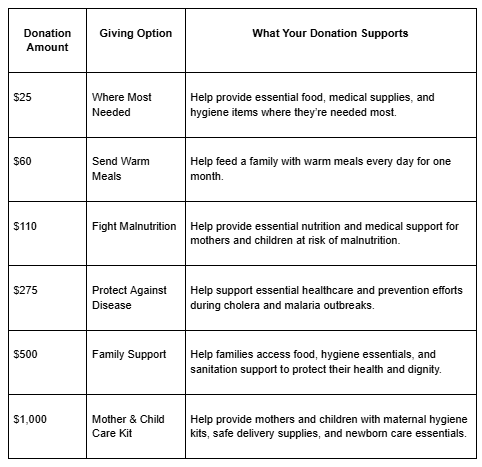
>> Donate to SAPA’s Gift Hope to Sudan campaign. Your contribution can help support essential food assistance, healthcare, neonatal care, and clean-water and sanitation initiatives.
FAQs
1. How do I know if a charity is legitimate?
Look it up on the IRS Tax Exempt Organization Search to confirm its 501(c)(3) status. Then check its website, leadership, and recent Form 990. Be cautious of pressure tactics or requests for gift cards and wire transfers.
2. When is the deadline for year-end donations to count for 2026 taxes?
Credit card gifts must be charged by December 31, 2026, and mailed checks must be postmarked by that date. Stock and wire transfers take longer, so start them by mid-December.
3. Is a GivingTuesday donation treated differently for taxes?
No. A GivingTuesday gift follows the same tax rules as a gift made on any other day. What matters is when the gift is completed.
4. Is it better to give to one charity or several?
Both work. Giving a larger amount to one trusted charity can deepen your impact and simplify your records. Spreading gifts lets you support several causes you care about.
5. Why does giving at year-end matter so much to nonprofits?
December brings in about 40% of the average nonprofit’s online one-time revenue. Those gifts often fund programs for months into the new year.
6. Why should I consider giving to humanitarian aid in Sudan?
Sudan faces one of the world’s largest crises, and its humanitarian appeal was just 41% funded in September 2026. Groups like SAPA deliver medical care, food, and clean water where it’s needed most.