Donating to a Charity in Sudan? 3 Questions to Ask Before You Give
 Mahnoor
If you’ve been following the news from Sudan, you’ve probably felt a strong urge to help. That instinct is worth acting on. UNICEF’s latest Sudan situation report counts 33.7 million people in need of humanitarian assistance this year, including 17.3 million children. Nearly 19.5 million people face acute food insecurity, according to the latest IPC analysis shared by FAO.
But when you’re donating to a charity in Sudan, good intentions are only half the job. Sudan is one of the hardest places in the world to deliver aid. Front lines shift, roads close, and aid workers face real danger. So the organization you choose matters just as much as the amount you give.
The good news is that you don’t need to be an expert to give wisely. Below are the three questions to ask before donating to a Sudan charity, along with quick ways to find the answers. Think of them as a friendly conversation with the charity, not an interrogation.
>> Related Post: What are Some Ongoing Projects by Sudan Aid Organizations?
3 Questions to Help You Choose a Sudan Charity:
1. Is the Charity Legitimate and Transparent?
Start with the basics. A trustworthy charity makes it easy to confirm who it is and how it handles money.
Check its registration
In the U.S., look for 501(c)(3) status and an Employer Identification Number (EIN). You can confirm both through the IRS Tax Exempt Organization Search, then read the charity’s Form 990 on ProPublica or Candid.
Look at independent ratings
Watchdogs like Charity Navigator, Candid, and the BBB Wise Giving Alliance review finances and governance.
Watch for red flags
- Pressure to give “right now” with emotional, high-pressure messages
- Financial reports that are missing or hard to find
- Vague claims like “we change lives” with no numbers behind them
- Requests to pay only by wire transfer, gift card, or cryptocurrency
- A brand-new website or fundraiser that appeared right after a news headline
2. Does It Have Real People and Real Access on the Ground in Sudan?
This question matters more in Sudan than almost anywhere else. A September 2026 UK government review of Sudan’s humanitarian situation notes that “attacks on aid workers and aid assets, and shifting front lines continue to restrict humanitarian access.” The same review highlights that local grassroots groups have stepped in to bridge gaps where international aid can’t reach.
In other words, a charity with no people on the ground may simply be unable to deliver what it promises. Organizations led by people who know Sudan, speak the language, and have long-standing community relationships can often reach places others can’t, and they tend to stay after the headlines fade.
What to look for
- Named locations. Does the charity tell you which states, towns, hospitals, or camps it works in?
- Local staff and partners. While short-term volunteers can help, local staff usually sustain the work.
- Recent field updates. Look for dated reports, photos, and stories from Sudan, not just stock images.
- Credible partnerships. Collaboration with UN agencies, ministries of health, or established NGOs suggests the charity can operate in complex settings.
3. Can It Show Where Your Money Goes and What It Achieves?
Once you know a charity is real and present, ask what your gift actually accomplishes.
Look beyond overhead
Well-run charities typically spend about 65–85% of their budget on programs. But very low overhead isn’t automatically good. Delivering aid safely in a war zone requires staff, logistics, monitoring, and security, and those costs are part of doing the job well.
A charity’s program-spending ratio can offer useful context, but it should not be the only measure of its effectiveness. Compare its financial statements with its reported results, fundraising costs, governance, and the resources needed to deliver aid safely in Sudan. In a conflict zone, spending on logistics, security, local staff, and monitoring can be essential to getting assistance to people who need it.
Ask for specific results
Strong charities share measurable outcomes: patients treated, children screened for malnutrition, meals served, water points repaired. ADRA also points out that honestly reporting setbacks is a good sign, not a bad one.
It also helps to see how a gift translates into something concrete. Many charities now show giving levels, such as what $25, $100, or $500 can provide. That kind of detail tells you the organization has thought carefully about costs and knows exactly what it is buying, whether that’s newborn care supplies, therapeutic food, or parts to repair a community water pump.
Check that it balances relief with lasting impact
Sudan needs both emergency aid and rebuilding. FAO reports that around 40% of health facilities are non-functional and an estimated 17 million people lack safe drinking water. Look for charities that feed families today while also restoring hospitals, water systems, and local health capacity.
Accountability matters even more because official funding is falling short. As of June 2026, Sudan’s humanitarian response plan was only 41.1% funded. Private donors are filling real gaps, so every dollar should count.
Your quick checklist
- Registered 501(c)(3) with a public EIN and Form 990
- Named locations and local teams inside Sudan
- Specific, recent results you can verify
- A mix of emergency relief and long-term solutions
>> Related Post: Top Sudanese Medical Charities to Donate to
How to Choose a Sudanese Charity You Can Trust: Why Donors Choose SAPA
If you’re still wondering how to choose a Sudanese charity, it helps to see what a strong answer to all three questions looks like.
The SAPA is a U.S.-based 501(c)(3) nonprofit (EIN 83-3464851), tax-exempt since 2019. Its network of Sudanese and Sudanese American physicians brings medical expertise and deep local knowledge to the crisis. SAPA publishes audited financial statements and reports a 4-star Charity Navigator rating and Candid’s Platinum Seal of Transparency.
On the ground: SAPA works across more than 13 Sudanese states. Its programs include:
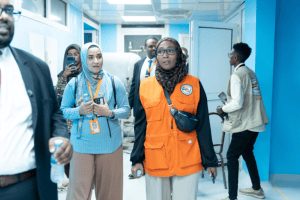
- Emergency healthcare in Sudan, including a free 80-bed hospital for displaced families in Medani, mobile clinics, cholera treatment units, and the rehabilitation of Ibrahim Malik Hospital in Khartoum
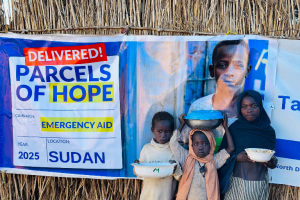
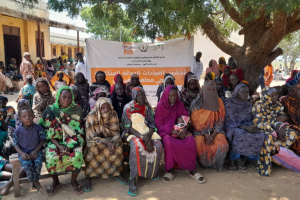
- The Sudan Hunger Relief Program, which serves 4,000 meals a day to displaced families in Tawila, North Darfur, through community kitchens run with local women
- Clean water projects in West Darfur, which build and maintain water systems in El Geneina, with a goal of reaching 50,000 people
- Save a Life in Sudan, which funds newborn care kits, neonatal units, and midwife training
Measurable results: SAPA has provided medical care to more than 700,000 patients, treating over 250,000 children under five, screening more than 300,000 children for malnutrition, and supporting 95 health facilities and 1,800 healthcare professionals.
>> Donate to SAPA and support community-led humanitarian efforts providing essential healthcare, food, and clean water across Sudan.
FAQs
1. Is it safe to donate to a charity in Sudan right now?
Yes, as long as you give through an established organization with teams already working inside the country. Access remains restricted by insecurity, so local presence is what turns your gift into real help.
2. What questions should I ask before donating to a Sudan charity?
Ask three things: Is it legitimate and transparent? Does it have real people and access on the ground? Can it show where your money goes and what it achieves?
3. How can I check if a Sudanese charity is legitimate?
Confirm its 501(c)(3) status and EIN with the IRS, review its Form 990 on ProPublica or Candid, and look it up on Charity Navigator.
4. What percentage of my donation should go to programs?
In conflict zones, some overhead is necessary for security, logistics, and monitoring, so look at results too.
5. Are donations to Sudan charities tax-deductible?
Gifts to a U.S.-registered 501(c)(3), like SAPA, are generally tax-deductible. Keep your receipt and check with a tax professional about your own situation.