Giving Tuesday 2026 Donations for Sudan and Where Help Matters Most
 Mahnoor
Giving Tuesday falls on December 1, 2026, and for millions of families in Sudan, the timing could not matter more. The war is now in its fourth year, and more than 30 million people, nearly two-thirds of the population, need humanitarian help. Hospitals have shut down, families are going hungry, and clean water is scarce in many displacement sites.
If you are wondering where your money will actually make a difference, you are asking the right question. Your Giving Tuesday 2026 donations for Sudan can keep a clinic open, feed a family, or stop a cholera outbreak before it spreads. The key is knowing which needs are most urgent and which organizations can reach people on the ground.
Why Sudan Needs Your Help This Giving Tuesday
Sudan is facing one of the largest humanitarian crises in the world, and the numbers keep growing. Here is a snapshot of where things stand this fall:
- 8.6 million people are displaced inside Sudan, with Darfur hosting about 65% of them.
- 19.5 million people face crisis levels of food insecurity, made worse by an El Niño drought.
- 37% of health facilities across the country have stopped working.
- 228 verified attacks on health care since April 2023 have killed 2,055 people.
At the same time, funding is falling short. WHO’s 2026 humanitarian appeal for Sudan is only 23% funded, and the World Food Programme is about one-third funded in the country. In September, IOM Director General Amy Pope warned that “the entire humanitarian system could collapse within weeks if we don’t act now”.
>> Related Post: How Giving Tuesday Matching Gifts Work and What Donors Should Understand
Areas Where Humanitarian Support Is Urgently Needed in Sudan:
Not every need is equal in a crisis this size. These are the areas where Giving Tuesday 2026 donations for Sudan have the biggest impact:
1. Emergency Healthcare and Medical Aid
With more than a third of health facilities closed, the clinics that remain are overwhelmed. When funding stops, care stops too. At one displacement camp in Hamidiya, daily consultations fell from 200 to about 40 after outside funding ended, and vaccinations were halted.
Donations to emergency healthcare services in Sudan pay for doctors, medicines, mobile clinics and maternal care in places where no other option exists.
2. Hunger Relief and Nutrition
Hunger is driving much of the illness in Sudan. Malnourished children are more likely to get severe cholera and measles, and WHO warns that famine risk is growing in parts of Darfur and Kordofan. In Tawila, where more than 700,000 displaced people now live, WFP can only provide half rations. Giving to a Sudan hunger relief program funds community kitchens and nutrition support that keep children alive through the hardest months.
3. Clean Water, Sanitation and Hygiene
Dirty water spreads disease fast in crowded camps. Sudan has recorded more than 124,000 cholera cases and over 3,300 deaths across 18 states since 2025. In the Al Obeid area, people are getting about 7 litres of water a day, less than half the 15-litre emergency minimum.
Supporting clean water for Sudan repairs handpumps, provides purification tablets and delivers hygiene kits that prevent outbreaks.
4. Mothers, Newborns and Young Children
Women and children carry the heaviest burden of this war. Pregnant women often have nowhere safe to give birth, and newborns need medicines that are hard to find. Targeted gifts for maternal and child health can save a life in Sudan in the most direct way possible.
How to Make Your Giving Tuesday Donation Count
A little research before you give helps your money go further. Keep these tips in mind:
- Choose an organization with access. Look for groups with local staff and partners who can reach conflict areas.
- Check transparency ratings. Charity Navigator and Candid show how a charity uses its funds.
- Confirm it is a registered 501(c)(3). US donors can then deduct gifts as the law allows.
- Give to a specific program. Healthcare, hunger or water gifts show you exactly where your money goes.
- Consider a monthly gift. Steady funding helps clinics and kitchens plan ahead.
- Share the cause. Start a fundraiser or post on social media to multiply your impact.
As UN Crisis Relief puts it, the goal of Giving Tuesday is to provide “support where it matters most.” In Sudan, that means getting care to people before it is too late.
>> Related Post: Giving in 2026? How to Tell if a Charity Is Tax Deductible
How SAPA Puts Your Giving Tuesday Donations for Sudan to Work
SAPA is a nonprofit network of Sudanese American physicians and healthcare professionals. Founded in 2019 and based in Texas, the organization works with healthcare professionals and local partners to support medical services and humanitarian programs in Sudan.
According to SAPA’s impact data, in 2025 alone SAPA:
- Provided medical care to more than 700,000 patients
- Treated more than 250,000 children under five
- Screened more than 300,000 children for malnutrition
- Vaccinated more than 90,000 children
- Supported 95 healthcare facilities and 1,800 healthcare professionals
Choose Your Giving Tuesday Gift
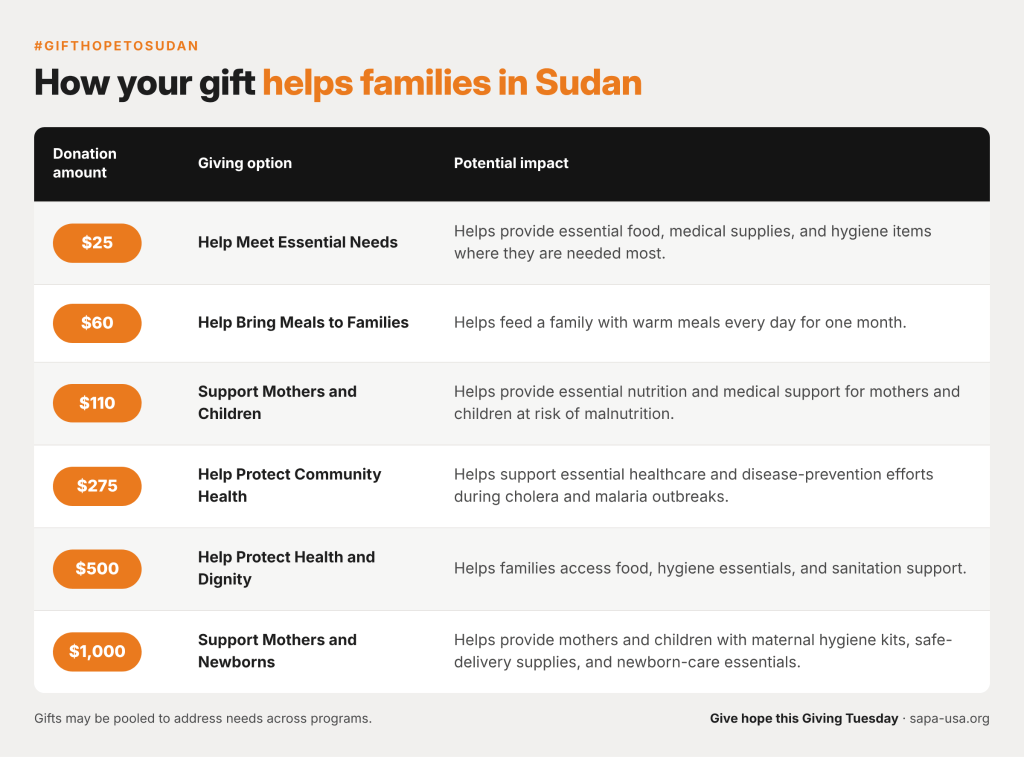
This Giving Tuesday, SAPA’s campaign supports emergency healthcare, hunger relief and WASH programs for families affected by the crisis in Sudan and Chad. Whether you can give $25 or $1,000, here is what your gift can help provide:
→ Donate to SAPA’s Giving Tuesday Campaign
FAQs
1. When is Giving Tuesday 2026?
Giving Tuesday 2026 is on Tuesday, December 1, 2026. It always falls on the Tuesday after Thanksgiving in the US. Many nonprofits, including SAPA, run campaigns throughout that week.
2. Why should I make a Giving Tuesday donation for Sudan?
Sudan has one of the world’s largest humanitarian crises, with more than 30 million people in need (ACAPS). Funding is falling short, so individual gifts help keep lifesaving services running.
3. Where is help needed most in Sudan right now?
The biggest needs are emergency healthcare, food, and clean water. Darfur and Kordofan are especially hard hit, with growing famine risk and a severe health crisis (WHO).
4. Is my donation to SAPA tax-deductible?
Yes. SAPA is a registered 501(c)(3) nonprofit, so donations are tax-deductible to the extent allowed by US law. Keep your receipt for tax season.