

If I Donate $1,000, How Much Can I Deduct From My Taxes?
 Mahnoor
A $1,000 charitable donation does not give you a $1,000 tax refund. A charitable contribution generally works as a tax deduction, which can reduce the amount of income subject to federal income tax. How much that deduction is worth depends on whether you qualify to claim it, how you file your taxes, and your marginal tax rate.
For 2026, there is an important change: taxpayers who take the standard deduction may claim a limited federal deduction for qualifying cash contributions, up to $1,000 for individuals or $2,000 for married couples filing jointly. Taxpayers who itemize can also claim charitable deductions, subject to additional rules, including a new 0.5% of adjusted gross income (AGI) floor. The IRS’s 2026 guidance on charitable contributions explains these changes in detail.
Here’s how the rules work, what a $1,000 donation could mean for your federal taxes, and what to know if you donate to a qualified organization such as the Sudanese American Physicians Association (SAPA).
A $1,000 Donation Is a Tax Deduction, Not a $1,000 Refund
A tax deduction reduces the amount of income on which you calculate your tax. A tax credit, by contrast, directly reduces your tax liability.
For example, if you have a fully deductible $1,000 charitable contribution and the deduction reduces income that would otherwise be taxed at a 22% marginal rate, the federal income tax reduction attributable to that deduction could be approximately $220.
That does not mean you receive a $220 refund automatically. Your final refund depends on your total tax liability, withholding, estimated payments, credits, and other parts of your tax return.
So when someone asks, “If I donate $1,000, how much tax refund will I get?”, the more accurate question is:
How much will my $1,000 charitable deduction reduce my federal income tax liability?
The answer depends first on whether the donation is deductible under the rules that apply to you.
Can You Deduct a $1,000 Donation in 2026?
For 2026, the answer can be yes, but the rules differ depending on whether you itemize deductions.
If You Take the Standard Deduction
Beginning with tax year 2026, eligible taxpayers who do not itemize can deduct qualifying cash contributions of up to:
- $1,000 for individual taxpayers
- $2,000 for married couples filing jointly
This deduction is available even when the taxpayer takes the standard deduction, subject to the applicable requirements. The IRS’s 2026 charitable-contribution guidance confirms that the non-itemizer provision applies to qualifying cash contributions to eligible tax-exempt organizations.
That means an eligible single taxpayer who gives $1,000 in qualifying cash contributions during 2026 could potentially deduct the full $1,000 even if they use the standard deduction.
If You Itemize Your Deductions
If you itemize, charitable contributions can generally be deducted when made to qualified organizations, subject to the applicable percentage-of-AGI limits and the new 2026 charitable-contribution floor.
For 2026, itemizers can deduct only the portion of their charitable contributions that exceeds 0.5% of their AGI. The IRS’s 2026 Publication 505 explains that contributions falling within the 0.5% floor cannot be deducted.
For example, if your AGI is $200,000, 0.5% is $1,000. If your qualifying charitable contributions for the year total exactly $1,000, none of that amount would be deductible under the new itemized-contribution floor.
If you give $2,000 instead, the amount above the $1,000 floor could potentially be deductible, subject to the other charitable-contribution rules.
This is one reason the same $1,000 donation can have a different tax result for different taxpayers.
>> Related Post: Charitable Giving Strategies for Tax Savings in 2026
What Is the 2026 Standard Deduction?
The 2026 federal standard deduction is:
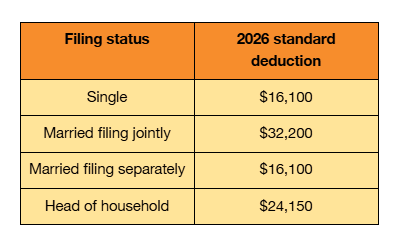
These amounts apply to tax year 2026.
The standard deduction matters because, before 2026, taxpayers generally needed to itemize to claim a federal charitable contribution deduction. Beginning in 2026, eligible non-itemizers can claim the limited cash-contribution deduction described above.
How Much Tax Could a $1,000 Donation Save?
If the entire $1,000 contribution is deductible, a simple way to estimate the federal tax effect is to multiply the deductible amount by the taxpayer’s marginal tax rate.
For example:
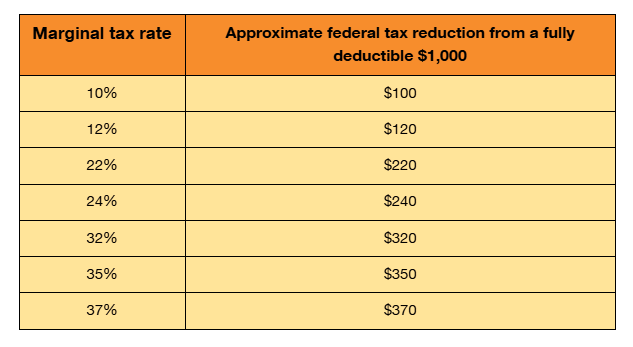
These are illustrative calculations, not guaranteed tax savings or refunds. They assume the full $1,000 is deductible and that the deduction reduces income taxed at the stated marginal rate.
The federal income tax brackets for 2026 remain 10%, 12%, 22%, 24%, 32%, 35%, and 37%.
Your actual tax result can differ because of the charitable-contribution floor, AGI limitations, the overall limitation on itemized deductions, filing status, other deductions and credits, and your overall tax situation.
Why Your Tax Bracket Matters
Tax brackets are marginal. Being in the 24% bracket does not mean every dollar of your income is taxed at 24%.
If a $1,000 fully deductible charitable contribution reduces income that would otherwise be taxed at 24%, the simple estimated tax reduction is $240.
The deduction does not itself create a $240 refund. It reduces tax liability, while your refund or balance due depends on the rest of your tax return.
What Is the 0.5% AGI Floor for Charitable Donations?
One of the major charitable-giving changes for itemizers in 2026 is the 0.5% AGI floor.
Under the new rule, an itemizing taxpayer generally cannot deduct the first 0.5% of AGI in charitable contributions. Only contributions above that threshold count toward the itemized charitable deduction, subject to the other applicable limits. The IRS’s 2026 Publication 505 provides the calculation used for this limitation.
For example:
AGI: $200,000
0.5% of AGI: $1,000
Charitable contributions: $2,500
Amount above the floor: $1,500
In this simplified example, $1,500 would be the amount remaining after the 0.5% floor, before considering any other limitations that may apply.
The calculation can become more complicated for larger donations or taxpayers with higher incomes, so donors making substantial contributions may want to consult a qualified tax professional.
>> Related Post: How Does a Charitable Donation Tax Deduction Work in 2026?
Are There Limits on How Much You Can Deduct?
Yes. Charitable deductions can be subject to percentage-of-AGI limits depending on the type of contribution and the organization receiving it.
For example, cash contributions to certain public charities can generally be deductible up to 60% of AGI, while different limits can apply to other types of property and organizations. Excess qualifying contributions may generally be carried forward for up to five years, subject to the applicable rules.
For a $1,000 cash contribution, these limits will not normally be the issue for most taxpayers. The more immediate questions are whether the organization qualifies, whether you can claim the deduction, and how the 2026 charitable-contribution rules apply to your filing situation.
Does a $1,000 Donation Increase Your Tax Refund?
Not necessarily.
A charitable deduction reduces taxable income or, for the new 2026 non-itemizer provision, provides an eligible deduction under the applicable rules. Your refund is determined by comparing your total tax liability with the amount already paid through withholding and estimated payments, along with any refundable or nonrefundable credits that apply.
For example, suppose a qualifying $1,000 donation reduces your federal tax liability by $220. If you had already overpaid your taxes by $500, your refund could increase by approximately $220, assuming nothing else changes.
If you had underpaid your taxes, the deduction could instead reduce the amount you owe.
That’s why tax savings and tax refunds are not the same thing.
What Records Do You Need for a $1,000 Donation?
Keep your donation records.
For cash, check, credit card, electronic transfer, or other monetary contributions, the IRS requires donors to maintain appropriate records showing information such as the organization, date, and amount of the contribution. You can review the IRS requirements for substantiating charitable contributions for the applicable recordkeeping rules.
For a single contribution of $250 or more, you generally also need a contemporaneous written acknowledgment from the charity. The acknowledgment should include the amount of the contribution and state whether the organization provided any goods or services in exchange for the donation.
For a $1,000 cash donation, keep:
- Your donation receipt or written acknowledgment
- Your bank or payment record
- The date and amount of the contribution
- Any documentation showing whether you received goods or services in return
The donor is responsible for obtaining the required acknowledgment, so don’t rely solely on a charity’s internal records.
What If You Receive Something in Exchange for Your $1,000 Donation?
A donation is not necessarily fully deductible when you receive goods or services in return.
For example, if you pay $1,000 to attend a charitable event and receive goods or services worth $300, the deductible portion is generally the amount above the value of what you received in this simplified example, $700.
These are known as quid pro quo contributions. The IRS requires charities to provide certain disclosures when a payment exceeds $75 and includes both a contribution and goods or services.
A straightforward cash donation to a qualified charity, where you receive nothing of value in return, is easier to document.
Give Year-End Donations (Fastest & Secure) 👇
If You Donate $1,000 to SAPA, What Does Your Donation Support?
SAPA is a U.S.-based 501(c)(3) nonprofit organization. SAPA states that it is tax-exempt and that donations are tax-deductible to the extent allowed by law.
SAPA’s current programs include healthcare and emergency response, medical supplies and medications, hospital infrastructure, hunger relief, and other humanitarian initiatives in Sudan. Its current projects provide examples of specific projects, including an oxygen-generation plant, medical-supply shipments, and emergency vector-control work.
SAPA also describes its broader healthcare and emergency services and its work supporting healthcare professionals through education, training, medical equipment, and other resources.
The tax treatment of a donation and the use of the donation are two separate questions. A qualifying $1,000 contribution may provide a federal tax deduction under the rules described above, while the donated funds support SAPA’s charitable programs.
>> If you are considering a donation, you can review SAPA’s programs and humanitarian work or Make a Donation

FAQs
1. If I donate $1,000, how much tax will I save?
There is no single answer. If the full $1,000 is deductible and the deduction reduces income taxed at your 22% marginal rate, the simplified federal tax reduction would be about $220. At 24%, it would be about $240.
Your actual result depends on whether the contribution is deductible and the rules that apply to your tax return.
2. If I donate $1,000, will I get a $1,000 refund?
No. A charitable contribution is generally a deduction, not a dollar-for-dollar tax credit.
A $1,000 deductible contribution reduces taxable income rather than automatically reducing your tax bill by $1,000.
3. Can I deduct a $1,000 donation if I take the standard deduction?
For tax year 2026, eligible taxpayers who take the standard deduction may claim a federal deduction for qualifying cash contributions of up to $1,000, or $2,000 for married couples filing jointly. The IRS’s 2026 guidance explains the non-itemizer deduction and its limitations.
4. What if I itemize my deductions?
If you itemize, charitable contributions can generally be deductible when made to qualified organizations, but 2026 introduces a 0.5% AGI floor for charitable contributions. Other limitations may also apply. IRS Publication 505 provides the current rules.
5. Does my tax bracket affect the value of a $1,000 donation?
Yes. If the entire contribution is deductible, the tax effect generally depends on the marginal rate applicable to the income reduced by the deduction.
For example, a $1,000 deduction at a 22% marginal rate represents about $220 in federal tax savings before considering other limitations.
6. Do I need a receipt for a $1,000 donation?
You should keep documentation for the contribution. For a single contribution of $250 or more, the IRS generally requires a contemporaneous written acknowledgment from the charity to substantiate the deduction. You should also retain the applicable bank or payment record.
7. Is a donation to SAPA tax-deductible?
SAPA states that it is a 501(c)(3) nonprofit organization and that donations are tax-deductible to the extent permitted by U.S. law. SAPA’s nonprofit and tax-exempt information provides its EIN and tax-exempt status. Individual taxpayers should consider their own circumstances and applicable IRS rules.
8. What is the 0.5% AGI charitable deduction floor?
For taxpayers who itemize in 2026, charitable contributions are generally deductible only to the extent they exceed 0.5% of AGI, subject to the other applicable charitable-contribution limitations.
9. Does a charitable deduction increase my tax refund?
It can, but not necessarily. A deduction reduces your tax liability when it is allowed. Whether that produces a larger refund or a smaller amount owed depends on withholding, estimated payments, credits, and the rest of your tax return.
10. Should I make a charitable donation just for the tax deduction?
A tax deduction can be one consideration when planning charitable giving, but it does not mean that a donation costs you nothing. You give money to a qualified organization and may receive a tax benefit depending on your circumstances.



Comment (1)
Deneme bonusu
Deneme Bonusu