Asila Arbab’s Story of Displacement with SAPA’s Healthcare Response in Blue Nile
-
by
 Mahnoor
- No Comments on Asila Arbab’s Story of Displacement with SAPA’s Healthcare Response in Blue Nile
 Mahnoor
Most stories of displacement are told in numbers. Asila Arbab’s is better told in moves.
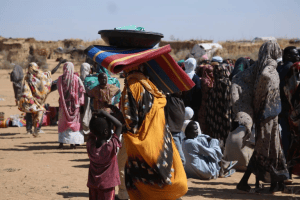
The first move took her away from her home in Qeisan, a locality in Sudan’s Blue Nile State, to a displacement camp. There, she gave birth to twins. The second move took her and her two newborns to an area called Rahmat Allah. In Arabic, the name means “God’s mercy”.
Asila is 35. By the time SAPA’s mobile clinic reached Rahmat Allah in late September, she had given birth and begun raising two babies, all while displaced from her home.
Sudanese families have long passed down their histories through stories told at home, a tradition explored in a podcast that brings Sudanese folktales to new audiences. Asila’s story belongs to a newer, harder chapter. This piece follows her journey, and shows how SAPA’s healthcare response in Blue Nile is trying to make sure mothers like her are not left without care at any stage.
Leaving Qeisan
Qeisan, also spelled Geissan, lies in southeastern Blue Nile, near the Ethiopian border. In recent months it has been at the centre of some of the state’s heaviest fighting.
In early November, Radio Tamazuj reported that thousands of people from Geissan were sheltering in forests, living under plastic sheeting and shelters made from branches. One displaced man told the outlet his family was still waiting for any help at all.
The fighting has spread well beyond Geissan. In early November, drone strikes hit Damazin, the state capital, and more than 3,000 families fled the city and its surroundings, Darfur24 reported. Blue Nile now hosts more than 175,000 displaced people, according to SAPA’s situation update, and many have moved more than once. That is the pattern Asila’s story fits. Displacement in Blue Nile is rarely a single journey. It is a series of them.
>> Related Post: Sudan’s Conflict & Displacement Crisis: What the Latest Data Shows
Giving Birth Far From A Hospital
For any woman, pregnancy under displacement carries risk. For a woman expecting twins, the risk is higher. Twin pregnancies are more likely to end in early labour, and twins are more likely to be born small, so mothers need closer monitoring before and after birth.
Asila gave birth in the camp. We do not know the details of the delivery, but the setting tells its own story. In Blue Nile’s camps, health monitoring is thin and needs are rising. At al-Karama 3 camp in Damazin, malnutrition among children climbed to more than 2,100 cases by November, a camp official told Al Jazeera, and families were arriving in very difficult conditions.
Across Sudan, the health system that should catch women like Asila has been badly broken. More than a third of health facilities have stopped functioning, according to the WHO.
Moving Again With Two Newborns
The weeks after childbirth are when mothers and babies are most vulnerable. This is when infections, bleeding and feeding problems are most likely to appear, and when regular check-ups matter most. Asila did not get to stay in one place. She left the camp with her twins and settled, for now, in Rahmat Allah.
Every move like that puts distance between a family and whatever care they had. It also means starting again: finding water, finding food, and finding out where the nearest health worker is, if there is one.
Funding cuts are making those gaps wider. In October, the International Rescue Committee warned that the few services still reaching displaced families in Blue Nile were at risk of collapse after its funding ran out. Nearly half a million people across Sudan had already lost health, nutrition and water services.
>> Related Post: Sudan’s Water Crisis is Growing. What Solutions Can Make a Difference?
When The Clinic Came To Her
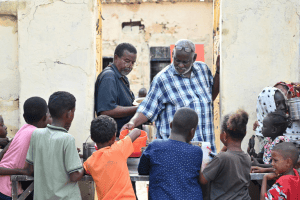
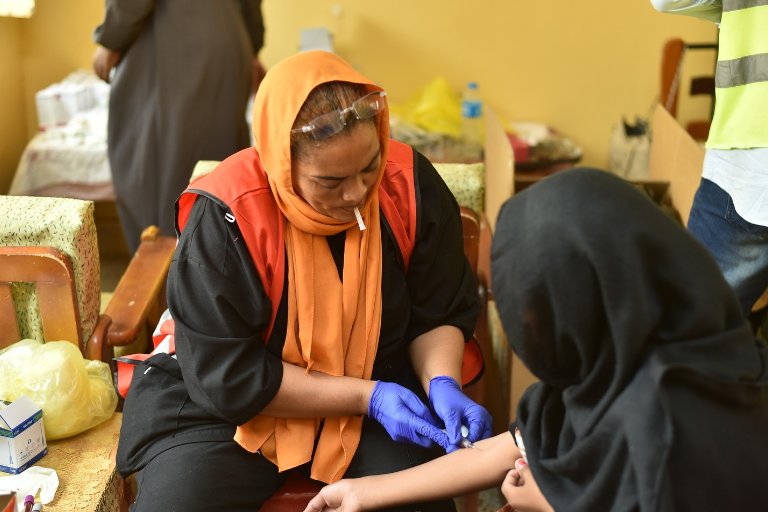
At the end of September, SAPA’s mobile clinic reached Rahmat Allah. For Asila, that meant care she had not been able to reach on her own. She received the medicines she needed and postnatal check-ups for herself and her babies. The team also gave her support and advice to reduce health risks for all three of them in the weeks ahead.
None of it was dramatic. It was ordinary care: a check-up, the right medicines and a health worker who could answer her questions. But for a mother who has been uprooted twice, ordinary care is exactly what is hardest to find. Asila was not alone. On 28 and 29 September, just before the clinic reached her, 76 pregnant women received care from the same mobile team in only two days.
What One Mother’s Story Tells Us
Asila’s journey shows something that numbers alone can miss: displaced mothers need care at every stage, not just once.
- During pregnancy, they need antenatal check-ups, vitamins and someone to spot complications early.
- At birth, they need a skilled midwife and a safe place to deliver.
- After birth, they need postnatal care, vaccinations for their babies and support with feeding and nutrition.
When a family keeps moving, each of those stages can happen in a different place. Fixed clinics, even where they still work, cannot follow them. A mobile team can.
>> Related Post: How SAPA is Supporting Clean Water Access for El-Geneina
How SAPA’s Healthcare Response in Blue Nile Supports Mothers Like Asila
SAPA was founded in 2019 by Sudanese American doctors who wanted to improve health care for Sudanese communities around the world. It is a non-partisan, 501(c)(3) humanitarian organisation based in Dallas, Texas.
SAPA’s mobile clinic in Blue Nile launched on 24 September 2026 and runs for about three months, with 66 clinic days planned. It focuses on Wad Almahi locality, where the gap in services is greatest, and also supports Ad Damazin. The work is done with Sudan’s Federal Ministry of Health and the Blue Nile State Ministry of Health, in coordination with the Humanitarian Aid Commission.
A team of 21 health workers, including a doctor, nurses, midwives, a pharmacist, vaccinators and a lab assistant, offers:
- antenatal and postnatal care, midwifery and reproductive health support
- routine childhood vaccines, malaria vaccines and tetanus vaccines for pregnant women
- nutrition screening, linked to SAPA’s hunger relief programme
- mental health support for families coping with repeated displacement
This is one part of SAPA’s healthcare and emergency services across Sudan. In 2025, the organisation reports, those services reached more than 700,000 patients. The aim is continuity: a mother who sees the team while pregnant should still be able to find care after she gives birth, even if she has had to move. For Asila, that is what happened.
FAQs
1. Who is Asila Arbab?
Asila Arbab is a 35-year-old mother from Qeisan locality in Blue Nile State, Sudan. She was displaced, gave birth to twins in a camp and later moved to the Rahmat Allah area, where SAPA’s mobile clinic provided her with postnatal care.
2. What is SAPA’s healthcare response in Blue Nile?
It is a mobile clinic programme that brings primary health care, maternal and newborn care, vaccinations, nutrition screening, mental health support and hygiene services to displaced communities in Blue Nile State.
3. Why are families in Blue Nile being displaced?
Fighting involving Sudan’s army and the Rapid Support Forces has spread across Blue Nile. In November, drone strikes on Damazin pushed thousands of families to flee, and earlier fighting in Geissan drove people into the forests.
4. How many displaced people are in Blue Nile State?
More than 175,000 displaced people are being hosted across Blue Nile State, according to SAPA’s situation update. More than 10,000 people were recently displaced from communities in eastern Blue Nile.
5. Why is postnatal care so important for displaced mothers?
The weeks after birth are when mothers and babies face the highest risk of infection, bleeding and feeding problems. For displaced mothers who keep moving, regular check-ups are hard to find without a mobile service.
6. Where does the mobile clinic operate?
It focuses on Wad Almahi locality, where the gap in health services is largest, and also supports Ad Damazin locality alongside existing providers.
7. Are children in Blue Nile’s camps affected by malnutrition?
Yes. At one camp in Damazin, child malnutrition cases rose to more than 2,100 by November, Al Jazeera reported. SAPA’s mobile team includes a nutrition assistant to identify cases early.
8. How can I help mothers like Asila?
You can donate through SAPA’s Donation Page. SAPA is a 501(c)(3) nonprofit, so US donations are tax-deductible to the extent allowed by law.