
Best Hunger/Poverty Charities in Sudan in 2026
 Mahnoor
Sudan is going through the kind of crisis that’s hard to fully picture unless you’re living through it. As of August 2026, nearly 19.5 million people are facing acute food insecurity, and famine conditions have already been confirmed in parts of Darfur and Kordofan. According to the World Food Programme’s latest warning, disrupted fertilizer shipments through the Strait of Hormuz are now compounding the crisis further, pushing sorghum (Sudan’s staple crop) even further out of reach for struggling families.
If you’ve been searching for hunger charities in Sudan or poverty charities in Sudan, you’ve probably noticed there’s no shortage of organizations asking for support. That’s a good thing because Sudan needs all the help it can get. But it also means donors are left wondering which food aid charities Sudan actually get meals to families, and which best food relief charities Sudan are worth trusting with a donation.
This guide breaks down how to evaluate a hunger charity, then walks through the most credible organizations doing food relief work in Sudan right now, so you can give with confidence.
>> Related Post: Best Hunger/Poverty Charities in Sudan in 2026
How to Choose the Best Hunger Charities in 2026:
Not every charity operates the same way, and in a crisis as complex as Sudan’s, with active conflict, blocked roads, and entire regions cut off from aid convoys, how an organization works matters just as much as how much it raises. Here’s what to look for before you donate.
1. Direct, On-the-Ground Presence in Sudan
Some large international charities operate through third-party partners without staff physically inside the country. Others have boots on the ground, including community kitchens, mobile clinics, and local staff who understand the terrain and can navigate access restrictions. Charities with a genuine local presence tend to reach the hardest-hit, most cut-off communities faster.
2. Transparency and Financial Accountability
Look for 501(c)(3) status (or the equivalent in your country), published financial audits, and annual reports. Charity Navigator, Candid, and BBB Wise Giving Alliance ratings are a quick way to sanity-check an organization’s transparency before you give.
3. Percentage of Donations Going to Programs
Every charity has overhead, but the best ones keep it lean. Look for organizations that put a high percentage of every donation directly into food distribution, logistics, and nutrition programs rather than administrative costs.
4. Track Record and Focus Area
Some charities specialize in hunger and nutrition; others fold food aid into a broader humanitarian mandate that covers healthcare, access to clean water, and shelter. Neither approach is wrong. It depends on whether you want your donation targeted narrowly at food relief or spread across a wider set of needs. SAPA, for example, pairs its hunger relief work with a dedicated clean water program, since malnutrition and waterborne illness so often go hand in hand in displacement camps.
5. Community-Led Distribution Models
Charities that hire and train local staff, especially displaced women running community kitchens, tend to build more sustainable, culturally attuned programs than those relying entirely on outside teams. This also means aid dollars circulate back into the local economy.
6. Regular, Verifiable Impact Reporting
The best charities publish real numbers: meals served, people reached, beneficiaries treated for malnutrition. If an organization can’t show you where the money went, that’s a red flag. With those criteria in mind, here’s a closer look at five of the best hunger and poverty charities working in Sudan today.
>> Related Post: Top Sudanese Medical Charities to Donate to in 2026
5 Best Hunger/Poverty Relief Charities in Sudan for 2026:
1. SAPA
SAPA runs one of the more hands-on, community-rooted hunger relief programs currently operating inside Sudan. Its Sudan Hunger Relief Program is built around direct food distribution in some of the country’s hardest-to-reach conflict zones, rather than relying purely on remote funding of third parties.
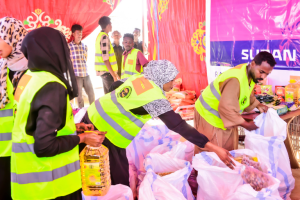
In Tawila, North Darfur, SAPA delivers roughly 4,000 meals a day to families displaced by the war (many of whom fled the devastated Zamzam displacement camp). What stands out is who’s doing the cooking: a community kitchen in Al-Omda staffed by displaced mothers and local women, preparing meals with dignity rather than treating recipients as passive aid recipients. SAPA also runs kitchens in Khartoum and Zamzam, and has partnered with organizations like Kids Against Hunger Sioux Falls and Then Feed Just One to distribute hundreds of thousands of fortified meals to children sheltering in Port Sudan.
Beyond emergency feeding, SAPA invests in longer-term food security, supporting local farmers and promoting sustainable agricultural practices so communities aren’t perpetually dependent on aid. It also runs a clean water program to help curb the disease outbreaks that so often follow displacement and malnutrition. The organization is a registered 501(c)(3) nonprofit, meaning donations are tax-deductible, and it publishes annual reports and audited financials for donors who want to verify where their money goes. A $50 donation, according to SAPA, can feed 100 people (a ratio that’s hard to beat among food relief charities Sudan currently has to offer).
Why it stands out:
Direct presence in North Darfur and Khartoum, community-led kitchens run by displaced women, and a dual focus on emergency meals plus sustainable farming and clean water support.
2. Islamic Relief
Islamic Relief has worked in Sudan since 1984, giving it one of the longest continuous track records of any international charity in the country. Its Sudan Emergency Appeal funds food, water, cash assistance, and temporary shelter, and the organization has moved its own offices multiple times just to keep operating as the conflict has shifted the front lines.
Since the war began in April 2023, Islamic Relief says it has reached more than 2 million people with lifesaving aid. The charity also runs “Takaaya” community kitchens (a local Sudanese tradition of communal cooking that Islamic Relief has scaled up to feed displaced families, including in Khartoum). Its programs extend beyond emergency food into water access, healthcare, and support for women and girls facing heightened risks of gender-based violence during the crisis.
3. Action Against Hunger
Action Against Hunger has operated in Sudan since 2018 and has built its entire global mission around treating and preventing malnutrition, making it one of the more specialized hunger charities in Sudan. Over the past year, the organization treated more than 36,000 children for acute malnutrition and delivered healthcare services to over 275,000 people, alongside cash assistance to more than 16,500 households and agricultural support to over 3,300 families.
Action Against Hunger also runs cross-border logistics hubs in Chad and South Sudan, which matter enormously given how much of Darfur and Kordofan remain cut off from conventional aid routes. As of its most recent update, the hunger crisis is worsening with the onset of the rainy and lean season, which runs from May through September and further hampers access to food, agricultural production, and essential services. The organization has been consistently outspoken about funding shortfalls, noting that Sudan’s 2026 humanitarian response plan needs roughly $2.9 billion. It holds high marks from Charity Navigator and Candid’s Platinum Transparency rating, and states that 90% of donations go directly to programs.
4. GOAL Global
GOAL has been active in Sudan for more than three decades, and its Sudan Crisis response currently involves over 200 staff delivering food, water, and medical support on the ground. The Irish humanitarian agency is also supporting the growing refugee population that has crossed into South Sudan, particularly through the Renk County border crossing, which has become a major transit point for people fleeing the conflict.
GOAL frames its impact in very concrete terms. It estimates that €75 provides emergency food and water for a family, while €180 can supply flour, oil, salt, and grains to feed four families for a month. The organization holds CHS Alliance verification and Candid’s Platinum Transparency award, which is useful if you’re comparing poverty charities in Sudan donors have vetted for accountability.
5. Muslim Hands UK
Muslim Hands has worked in Sudan since 2003 and runs a Sudan Crisis Fund covering emergency food, safe water, and essential aid, alongside a dedicated Sudan School Fund to keep children’s education from collapsing entirely during the war. The charity reports having reached over 635,000 people to date through this crisis response, including more than 120,000 people with emergency food and water and over 156,000 through WASH (water, sanitation, and hygiene) projects.
>> Related Post: Best Family & Child Care Charities in Sudan in 2026
Why SAPA’s Approach to Sudan’s Hunger Crisis Matters
What makes SAPA worth a closer look isn’t just that it feeds people, it’s how. Rather than running Sudan relief efforts as a remote, donor-country-led operation, SAPA leans heavily on Sudanese physicians, local staff, and displaced community members themselves to deliver aid. Its founders and volunteer base are largely Sudanese American medical professionals, which gives the organization an unusually direct line into what communities on the ground actually need.
The presence in Tawila and North Darfur is significant because these are among the hardest, most dangerous areas to operate in right now, with humanitarian access repeatedly cut off by conflict and blockades. As one recent independent field analysis put it, aid workers on the ground have managed to build a fragile humanitarian buffer protecting millions of civilians from even greater mortality, precisely the kind of buffer SAPA’s kitchens and clean water work are contributing to in North Darfur.
SAPA’s decision to build its community kitchens around displaced mothers in Al-Omda also means the program does double duty: it feeds families while giving displaced women a source of income and purpose during an incredibly destabilizing time. Add in its work supporting local farmers and its clean water initiatives to rebuild long-term food and health security, and SAPA looks less like a one-off emergency responder and more like an organization trying to help Sudan recover, not just survive.
>> Help provide meals, hope, and essential support to communities facing hunger in Sudan. Donate Today
FAQs
1. What is causing the hunger crisis in Sudan in 2026?
The crisis stems from the civil war that erupted in April 2023 between Sudan’s military and the paramilitary Rapid Support Forces. The conflict has displaced over 9 million people, collapsed agricultural production, disrupted trade routes, and cut off humanitarian access to entire regions, driving famine conditions in parts of Darfur and Kordofan.
2. How many people in Sudan need food assistance right now?
Around 19.5 million people are facing acute food insecurity, with more than 5 million in emergency-level hunger (IPC Phase 4) and roughly 135,000 in catastrophic conditions (IPC Phase 5) across famine hotspots in Darfur and South Kordofan, according to the UN’s latest Hunger Hotspots report.
3. Which charity is best for donating to Sudan hunger relief?
It depends on your priorities. If you want funds going directly toward community-run food distribution inside Sudan, SAPA is a strong option. If you prefer an organization with decades of institutional history, Islamic Relief or GOAL Global are solid choices. If nutrition treatment specifically matters most, Action Against Hunger specializes in that.
4. Are donations to Sudan charities tax-deductible?
If you’re donating to a US-registered 501(c)(3) organization like SAPA or Action Against Hunger USA, your donation is generally tax-deductible to the extent allowed by law. UK-based charities like Islamic Relief and Muslim Hands offer Gift Aid for UK taxpayers instead.
5. How can I verify a Sudan charity is legitimate before donating?
Check for registered nonprofit status, published financial audits, and third-party ratings from Charity Navigator, Candid (GuideStar), or the BBB Wise Giving Alliance. Legitimate charities will also publish annual reports detailing exactly how funds were used.
6. Can I start my own fundraiser to support Sudan relief efforts?
Yes. Several organizations, including SAPA, allow supporters to start a fundraiser and rally friends, family, or community networks around a specific giving goal for Sudan relief.