Which Organizations are Currently Providing Aid to Sudan?
 Mahnoor
Sudan’s civil war has created the world’s largest displacement and hunger crisis, and a handful of humanitarian organizations, including SAPA, Islamic Relief, Doctors Without Borders, the International Rescue Committee, and Save the Children, are working around the clock to deliver food, healthcare, and clean water to millions of people. Here’s who’s helping, what they’re doing, and how you can support their work.
If you’ve been asking yourself, “Which organizations are currently providing aid to Sudan,” you’re not alone. Since conflict started in April 2023, Sudan has become the site of the largest humanitarian crisis on the planet. More than four years into the conflict, over 30 million people need some form of humanitarian assistance, and millions have been forced from their homes.
Behind the grim statistics, though, is a network of relief organizations still finding ways to reach people in Darfur, Khartoum, Kordofan, and the refugee camps of neighboring Chad and South Sudan. This guide breaks down which groups are currently active on the ground, what kind of aid they’re providing, and how you as an individual can plug into that effort, including through SAPA’s own healthcare, hunger relief, and clean water programs.
>> Related Post: Which Organizations are Providing Medical Aid/Healthcare in Sudan?
Why Sudan Needs This Level of Aid Right Now
Sudan’s crisis isn’t a single emergency but rather a culmination of several emergencies. The International Rescue Committee reports that around 14 million people have been displaced since the war began, including more than 4.5 million who fled across borders, making this the world’s largest and fastest-moving displacement crisis. At the same time, more than 70% of the country’s hospitals are no longer functioning, and cholera has spread through camps and cities alike.
Food insecurity has followed the same trajectory. Save the Children has documented famine-level malnutrition rates spreading into new localities, with global acute malnutrition reaching nearly 53% in some areas of North Darfur as of early 2026. Save the Children’s own reporting notes that the 2026 UN humanitarian appeal for Sudan was only about a quarter funded months into the year, leaving relief groups stretched dangerously thin even as needs climb.
Access is the other half of the problem. Aid convoys are frequently blocked, and violence has recently intensified around cities like El Obeid in North Kordofan, where more than 5,500 children were displaced in just two weeks in late June and early July 2026 amid drone strikes and blockades on fuel and water supplies. This is the backdrop against which every organization on this list is operating.
>> Related Post: What Humanitarian Impacts Are Happening in Sudan Right Now and How Can I Help?
Organizations Currently Providing Aid to Sudan:
1. SAPA
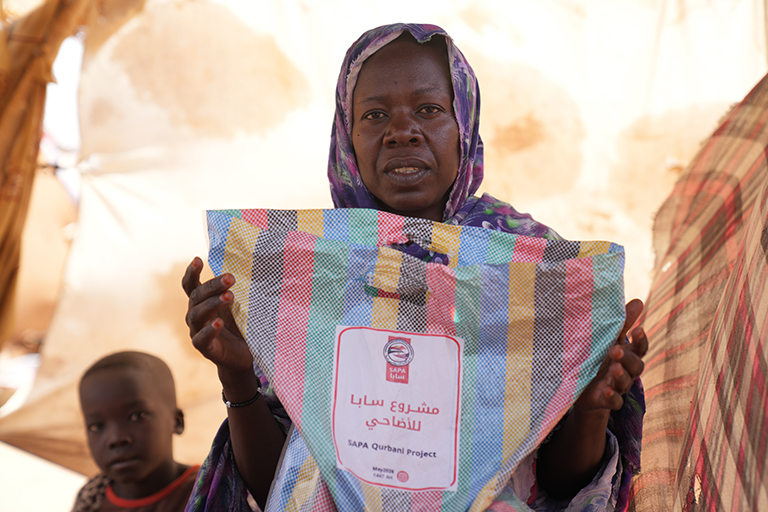
SAPA is a physician-led, nonprofit humanitarian organization founded by Sudanese American doctors who understand the country’s health system from the inside. Rather than working from the outside in, SAPA channels the expertise of Sudanese and Sudanese-American medical professionals directly into the response, training local providers, staffing mobile clinics, and keeping hospitals stocked with essential supplies.
SAPA’s impact across Sudan has been remarkable. More than 750,000 patients have received medical care, while over 3 million meals have been distributed to vulnerable families. Healthcare for children remains a priority, with 283,000 treated under the age of five, 319,000 screened for malnutrition, and 103,000 vaccinated. SAPA has also supported 106 healthcare facilities and empowered 1,973 healthcare professionals, alongside training 14,000 medical volunteers. To extend reach, 397 mobile medical clinics have been deployed, serving communities across 13 states in Sudan.
Its work spans three connected pillars:
- Healthcare and Emergency Services: rapid medical response, mobile clinics, and support for hospitals and health workers operating in conflict zones.
- Hunger Relief Program: meal distribution and malnutrition screening for displaced families and children under five.
- WASH Program: clean water, sanitation, and hygiene projects designed to prevent cholera and other disease outbreaks in overcrowded camps.
2. Doctors Without Borders / Médecins Sans Frontières (MSF)
MSF is one of the few international medical organizations still operating in the hardest-hit parts of Sudan, including areas of Darfur and Kordofan that many other groups can’t reach. Its teams (more than 2,000 Sudanese and international staff) run hospitals, treat malnutrition and cholera, deliver babies, and respond to mass-casualty events, including a recent wave of drone strikes near the Chad-Sudan border that has repeatedly overwhelmed MSF’s trauma teams in Chad.
MSF also documents the human cost of the war in stark numbers: in a recent operational update, the organization reported hundreds of thousands of outpatient consultations, tens of thousands of vaccinations, and thousands of surgical interventions carried out in Sudan over the past year alone.
3. International Rescue Committee (IRC)
The IRC has named Sudan the world’s most at-risk country on its Emergency Watchlist for three years running. Inside Sudan, the IRC runs water and sanitation programs, child protection and gender-based violence services, and health and nutrition care through more than 30 facilities. It also supports Sudanese refugees who’ve crossed into Chad, Ethiopia, and South Sudan, which are regions where, as the IRC notes, funding cuts have already forced some partner organizations to scale back essential services.
>> Related Post: What Efforts Are Being Made to Address Food Shortages in Sudan?
How SAPA is Helping Provide Aid to Sudan
SAPA is a scientific, professional, and humanitarian organization founded in January 2019. As a membership-based association, SAPA brings together physicians and medical professionals who live and work primarily in the United States. SAPA’s mission is to empower Sudanese healthcare professionals in the U.S. while advancing medical education, expanding healthcare access, and providing humanitarian aid to communities in Sudan and beyond.
When people ask what organizations are currently providing aid to Sudan, SAPA’s model is worth a closer look precisely because of who’s behind it. SAPA was founded by Sudanese American physicians who saw firsthand how underfunded and understaffed Sudan’s healthcare system was, even before the current war made things dramatically worse.
That physician-led structure shows up in how SAPA operates day to day. Its Healthcare and Emergency Services program deploys mobile medical teams and trains local providers so that care doesn’t stop when a facility loses staff or supplies. Its Hunger Relief Program targets one of the most urgent threats to children under five: acute malnutrition, which continues to climb as farming and food markets remain disrupted. And its WASH Program tackles a less visible but equally deadly problem: the cholera and waterborne disease outbreaks that spread quickly through crowded, under-resourced displacement camps.
FAQs
1. Which organizations are currently providing aid to Sudan?
Major organizations actively responding include SAPA, Islamic Relief, Doctors Without Borders (MSF), the International Rescue Committee, and Save the Children, alongside UN agencies like OCHA, UNICEF, and the World Food Programme.
2. Why is Sudan considered the world’s largest humanitarian crisis?
Sudan combines the world’s largest displacement crisis, one of its worst hunger emergencies, and a collapsing health system all at once. More than 30 million people need assistance, and over 70% of hospitals in conflict-affected areas are no longer functioning, according to OCHA’s Sudan overview.
3. How can I help Sudan from the United States?
The most direct way is donating to organizations with active, verified programs on the ground, such as SAPA’s Save a Life in Sudan campaign. You can also raise awareness, volunteer remotely, or support advocacy efforts pushing for increased humanitarian funding and access.
4. Is it safe for aid organizations to operate inside Sudan?
It’s extremely difficult. Both warring parties have restricted humanitarian access, and health workers and aid convoys have come under direct attack. MSF and Save the Children have both reported drone strikes and blocked routes disrupting deliveries in 2026, particularly around North Kordofan and Darfur.
5. What kind of aid do these organizations provide?
Coverage spans emergency medical care, malnutrition treatment, clean water and sanitation (WASH), food distribution, child protection, education, and mental health support. SAPA, for example, runs dedicated healthcare, hunger relief, and WASH programs side by side.
6. How many people in Sudan currently need humanitarian assistance?
More than 30 million people, about two-thirds of Sudan’s population, need some form of humanitarian aid, based on the 2026 Humanitarian Needs and Response Plan referenced by OCHA.
7. Which areas of Sudan are hardest hit right now?
Darfur, Khartoum, and Kordofan states have seen the most intense fighting and displacement. In mid-2026, escalating violence around El Obeid in North Kordofan displaced thousands of children in just weeks, according to Al Jazeera.
8. Is SAPA a legitimate, tax-deductible nonprofit?
Yes. SAPA is a 501(c)(3) nonprofit organization based in Dallas, Texas, and donations are tax-deductible to the extent allowed by law. You can review its programs and impact reports directly on sapa-usa.org.
9. Are refugees from Sudan also receiving humanitarian aid?
Yes. Organizations including SAPA, IRC, MSF, and Save the Children run programs in Chad, Uganda, South Sudan, and Ethiopia specifically for Sudanese refugees, covering healthcare, nutrition, and protection services in and around border transit centers and camps.
10. Why is the Sudan humanitarian response underfunded compared to other crises?
Humanitarian officials and aid groups have repeatedly flagged that Sudan receives far less media attention and donor funding relative to its scale of need. Save the Children has noted that the UN’s 2026 appeal for Sudan remained only partially funded well into the year, forcing organizations to prioritize the most severe cases over comprehensive coverage.